This message started from a succession of posts on the Mastodon server, written from September 10 to September 13, written in the middle of the explosion of AI-proven results in mathematics. My goal was to explain to a large audience what it means to prove a theorem, what it means to have formalized proofs, and why this could be relevant. I was asked to gather them into a more readable form, but other duties postponed my promise. Meanwhile, there were several other developments, some of them dramatic, but I don't think that they really change my view beyond the obvious additional level of sideration (and sickness).
The most recent case of the finite time solution of the forced Navier-Stokes equation has been discussed a lot in the recent days (this was September 10, 2026), both on this network and in the mainstream press, and I wish to try to give a perspective on what happened recently. This is prompted by a friend informing me this morning of two annoying additional stories that taint the recent public success of AI generated proofs and will hopefully lead the mathematical community to address the question of predation and plagiarism.
However, I won't address here the even more important questions posed by AI companies beyond merely quoting some of them:
- its energetic cost;
- its impact on minerals and other natural resources;
- its direct and immediate consequences on the ecosystem (water heating, pollution, land waterproofing, etc.);
- its impact on the work market, in particular those prompted by (actual or alleged) productivity gains; - its impact on learning, cognition, etc.;
- its impact on the economic structure, tremendous announced gains/losses of companies that look like a Ponzi scheme;
- its impact on the power structure, who owns what, who gives access to what;
- its impact on the political structure, the surveillance capitalism, etc.
These are fundamental issues that should be addressed more clearly in the mainstream medias, and that, in my view, suffice to object to the existence of AI.
Anyway, what does it mean for academic math?
Mathematical proofs, from objects to language
Before going on specific matters, I need to go back to what math is and to what it does. (TL-DR;-) As far as it goes about automatization, math is probably the easiest of all sciences.
In 1994, the mathematician William Thurston published a paper with the title “On proof and progress in mathematics” in which starts with stating the question What is it that mathematicians accomplish? His answer — you might find it circular — is that mathematicians are those scientists who push the human understanding of mathematics forward.
This means that mathematicians have under the eyes a whole range of (abstract) objects for which they use sometimes colloquial names (group, ring, field, memberhip, sheaf, relation, knot, crystal…) and sometimes more specific names (perfectoid, hypersolvable, function, proof, set…) and they try to better understand the properties that these objects possess, and the relations between them.
A whole field of mathematics is motivated by the fact that some of these objects model phenomena of the actual world in which we live, with the idea that the behaviour of the abstract mathematical objects might help us make actual decisions.
But a large part of mathematics is just motivated by these abstract objects themselves, possibly with the hope that, some day, they could be useful to the real world, and sometimes in the expectation that they will never be useful to it. For example when being useful means helping killing people.
We have traces of mathematical activity for more than 3000 years now, so it seems that this human desire to understand, in an abstract way, our surrounding world is quite deeply ingrained in our minds.
This quest has been parallel to the development of science, often prompted by questions of other sciences, but what happened in the modern era (beginning of 19th century, say), is more explicit desire for rigour in the argumentation. Not that mathematics lacked rigour, it always had a lot, like all science do, but mathematicians felt the need to have more precise definitions for their abstract objects. Mostly because standard reasoning often led mathematicians to oddities, if not mere absurdities.
Let me quote just here the discovery by Bertrand Russell that if you wish to talk about collections of which things may, or may not belong, you need to be extremely careful. Russel's remark is simple: imagine you can create collections of anythings, for example collections of collections, and so on (after all, you can have a bag to keep all of your bags together…), then it might be possible that a collection be a member of itself (the idea of an idea is an idea…), and you could look at the collection R of all collections that are not a member of itself. This collection R is paradoxical : saying that the collection R is a member of R exactly means that it is not a member of R.
After this logical disaster, mathematicians took a great more care to elaborate the way they can argue so that they don't fall into such absurdities. And they devised a way for that, which is the idea that mathematics could be (should it be?) framed in a specific language that is completely specified and devoid of any ambiguity. (Think about when Marx writes that “the history of all previous societies has been the history of class struggles”, what does he exactly mean by history, by societies, by class, by struggle?)
This quest seems to go back to the philosopher Wilhelm Leibniz, and at the beginning of 20th century, the mathematician Giuseppe Peano suggested a very specific way of writing mathematics that, theoretically, so he believes, would solve the problem.
I copy the first nine lines of his work on “natural numbers” (the numbers 1, 2, 3,…) and maybe you'll feel relieved that we don't learn to write this in high school.
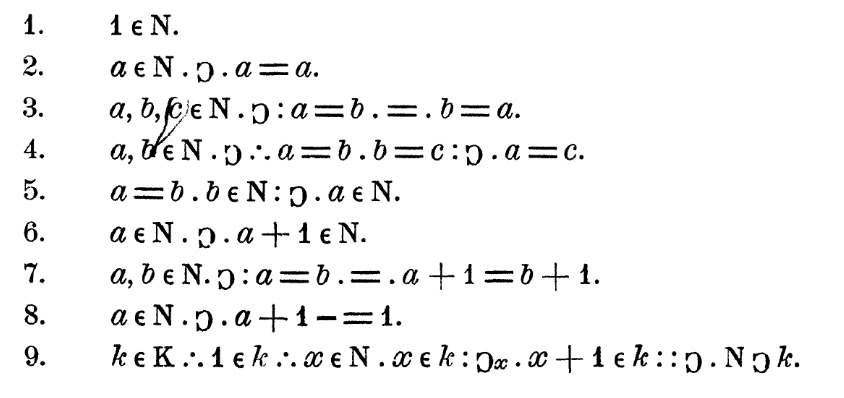 Moreover, mathematicians refined their model of argumentation (so called proofs) so that it fits such a specific way of being written.
The outcome is called a “formal proof”, with the idea that no mathematician ever writes an actual formal proof, but that we produce an argumentation that, to the eye of a trained mathematician, could be transformed more or less mechanically into such a proof.
After World War 2, the development of computers made possible that computers handle formal writings and formal proofs, and this started a scientific field (at the interaction of mathematics and computer science) of automated theorem proving. This is quite an interesting scientific activity, because experience shows that progress in that field relies both on a deep understanding of both computer science (otherwise, nothing works so well, algorithms are too slow…) and the mathematics involved. Computer scientists are also pretty much interested in that, because a formal mathematical proof of a formal mathematical statement is very close to an argumentation that your software code actually executes in the way you have specified. And it's not so bad to know that the software that manages train schedules doesn't behave in an unpredictable way when two trains arrive at the station almost at the same time.
A large number of softwares have been developed to that aim, Automath (by N. G. de Bruijn) was maybe the first one in 1967, I wish to name Coq/Rocq that has been developed in France using ideas from computer software, and Lean has been quoted many times recently, in particular because it is the one mentioned in these AI stories.
This is slightly off topic here, but I wish to make a digression and mention that mathematicians also discovered with quite a surprise that not everything can be proved: there are seemingly natural mathematical statements (the one which are well specified, without any ambiguity in them) about which one cannot conclude if one only follows the strict reasoning rules that I evoked. This has the interesting philosophical conclusion that many of our mathematical objects, those given by inambiguous specifications as requested above, are in fact not as well specified as we wished. This has the humble consequence that Hilbert's motto about mathematical quest, We must know, we will know (Wir müssen wissen, wir werden wissen), is in part hopeless. You can even listen to him saying these words at the end of a 1930 radio address.
Let us go swiftly to modern times and to modern mathematics.
Mathematical problems
As all scientific fields, it is organized along certain rules, the kind of rules that sociology of science could detail, and also explain their utility and their problems.
First there is a multi-faceted compartmentalization of the mathematical activity:
- It mostly takes place in research departments of universities, but there are also research departments in private companies (especially for applied research), as well as public places where fundamental research is done (Institute for Advanced Study in Princeton, or the Chinese Academy of sciences, etc.)
- The activity is separated along broad research themes (my department has a handful of large teams, each of them could be split into 3 or 4 smaller if needed), which has the consequence that few people have a deep understanding of what happens in the offices next to them.
- The field is driven by several lighthouses, whatever their actual scientific relevance is: In 1900, Hilbert had proposed 23 problems, in 2000 the Clay foundation proposed 10 other problems, each area of mathematics has a small list of questions which are thought of as particularly important (and for which mathematicians often use the word conjecture).
- There are also lists of possibly easier problems, the kind of those should be accessible as soon as you have a basic knowledge of a small are of mathematics. There are even problems that are thought of as accessible, meaning that a professional mathematician who knows a moderate sample of the bibliography should be able to solve them. This makes possible to have an ongoing science, with incremental successes. Many PhD theses are of this kind which I find regrettable, meaning that a professional mathematician is often in position to solve it before the apprentice mathematician even could—only ethics and communication can prevent that.
- Finally, prizes, medals, journal rankings, institution rankings, academic positions etc. that assess (and distort) in real time the scientific value that mathematicians give to individual achievements.
Already several years ago, AI companies have decided to enter the game of mathematics.
Their official motivation (I quote from memory one of the Google Deepmind leaders, last year at Leiden) is to provide us with new tools. But sometimes, the word escapes them that they wish to simply “solve mathematics”.
It should be made clear that in now way can anybody “solve mathematics”.
What is possible is solving a given mathematical question, or more likely, proving something related to a given mathematical question that the mathematical community views as an advance towards that question. Once a problem is solved, new problems emerge, either because the earlier question now makes it possible to set, or because we naturally turn our eyes to something else. Mostly, solving a question indicates that some mathematical tools are powerful and we wish to try those tools on questions that we feel could be addressed with them.
What is also possible is “disrupting mathematics” by disrupting the fragile equilibrium of the field, as a sociological construct. But they wouldn't want to do that, would they?
A hot mathematical summer
I will now try to summarize the events of this hot mathematical summer.
Mid July, Levent Alpöge, a mathematician trained at Harvard in number theory who is now working for the AI company Anthropic, published a counterexample to the so-called “Jacobian conjecture”. This was a natural question in a field called algebraic geometry that had been put forward in the 1960s by mathematicians such as Zariski and Abhyankar, especially because its statement doesn't require anything more than basic undergraduate algebra. (As it happens very often, earlier traces of this question can be found, back to the end of the 19th century.)
We are facing here a basic question, which was clearly an open conjecture in the field, but whose sociological status was unclear. Indeed, very few prominent mathematicians decided to tackle it, while a number of people with less competence devoted a lot of their energy to prove it. We now know that it has been in vain, but even there, one could have doubted the mathematical interest of the question, and one important algebraic geometer said me so in very clear terms around 2012.
Indeed, this conjecture asserted that every family \((f_1,..,f_n)\) of \(n\) polynomials in \(n\) variables with complex coefficients whose Jacobian is a nonzero constant is invertible. (Conversely, it is quite easy to prove that for any such family which is invertible, the Jacobian is a nonzero constant.) What this colleague made me observe is that it is extremely unlikely that one gets such a family for which we can prove that the Jacobian is a nonzero constant *without* already knowing that it is invertible. So what is this conjecture good for?
Anyway, we now know for sure that the conjecture is false. And although we have a proof, meaning an intelligible text that mathematicians could read and understand, we don't really know how Alpöge came to produce this example, beyond his claims: he just published a tweet saying the following:
hello there the jacobian conjecture is false thanx to my close friend akhil for asking about it and my other close friend fable for working during the world cup final
((1+xy)^3 z + y^2 (1+xy) (4+3xy), y + 3 x (1+xy)^2 z + 3 x y^2 (4+3xy), 2 x - 3 x^2 y - x^3 z): \C^3\to \C^3, has jacobian determinant -2, and sends (0, 0, -1/4), (1, -3/2, 13/2), and (-1, 3/2, 13/2) to (-1/4, 0, 0)
Here, “akhil” is another mathematician, Akhil Mathew, and “fable” is not really a friend but one of the AI softwares that was just released by Alpöge's company Anthropic.
So what happened?
If we digest the tweet, we can guess that Mathew has suggested to Alpöge that the Jacobian conjecture might be wrong (already a nice insight), or maybe that it would just be worth being investigated by this software (and then, some credit would go to Alpöge to try to search both for a proof and a disproof).
Automatizing mathematics
What happened really, we will probably never know, but we can think about how this kind of software works.
This software, Claude Fable 5, is a fairly sophisticated program that belongs to the class of “large language models” (LLM). Basically, this means that it generates text (language) according to probabilistic rules that are sufficiently well crafted that the outcome looks very well written, but still, at the heart, this is a randomly generated text.
Of course, there is no hope that a purely random text would be of any use for anybody, so the heart of the work of the LLM engineers was first to make these probabilistic rules particularly well chosen. On can already see this as a remarkable achievement of that kind of technology, but it is important to make two additional observations:
- The crafting of these probabilistic rules is obtained by a recent technique in machine learning (reinforcement learning and transformers), that requires, to work properly, an extremly large number of data. To that aim, the AI companies basically scanned every possible literature, and used human workers (in particular from the Global south) to “train” the software. It is for this reason that researchers in artificial intelligence and linguistics coined the term “stochastic parrots”: this software randomly repeats what it has read.
- This random text generation does not entail any notion of truth, and even any relation to the actual world. To reach the possibility of doing math, this software now combines text generation with proof verification in the sense discussed earlier. The reason that makes it workable in mathematics is precisely that the mathematical language is well specified, and we have means to assert the validity of a mathematical argument, combined with the performance of proof assistants.
This kind LLM technology is called “agentic” because it has the possibility to launch programs that can either be proof assistants that will try to check specific assertions, or other LLM agents that are instructed to counter-reason the arguments of the first one, in the hope of finding limitations of the initial plan.
While I know a fair amount of mathematics from my own reading, and my own practice, I am not a specialist of these technologies, I have no idea at all of how these multi-agents are combined, and I may be slightly off here. But one of my objections that I had earlier regarding LLM technology and “intelligence” is that I see no argument for which automatic generation of arguments, possibly looking in various directions at the same time, has anything to do with the stunning phenomenon called intelligence that we, humans, are used to experiment — and that we seem to share with some other living species. My basic objection is that it is up to the builders of those tools to demonstrate by thought, not by experiment, why it should work.
On the possibility of automatizing mathematics
We see that these technological systems are presented to us as sorts of “ultimate theorem proving” machines, capable of producing proofs of the most difficult questions that mathematicians asked themselves.
However, there cannot be any such machine, and we know that since 1936.
Indeed, at the time where Hilbert framed his program and formulated the decision problem which we talk about using its German name, Entscheidungsproblem (remember the above “We must know”?), some logicians were studying this question thoroughly and came to a negative answer.
First came Tarski and Gödel who observed that in a (reasonable) formal system where one can talk of theorems and their proofs, there must be undecidable statements: things that look like a valid theorem but of which no proof exists, and of which no proof of the opposite exists neither. This means that even if we believe that the axioms of such formal systems describe mathematical objects of some idealized mathematical world, those axioms cannot explain all properties of those objects. Of course, one could add axioms to settle undecidable questions, but new undecidable questions would automatically arise. (“Reasonable” means that the list of axioms of such a formal system can be printed by some computer program, and that they are strong enough so as to allow to talk about numbers and arithmetic.)
Then came Church and Turing who first gave a proper definition to what it means to make a computation (Church's lambda-calculus), or to run a program (Turing's machines). Then they proved that there is no computer program that, given any other program, could decide whether it would run to an end or compute indefinitely. Turing's proof is not so difficult for us, who are accustomed to computer programming, but this was 1936, and Turing needed to imagine what a computer could be. Then, Turing could essentially mimick Russel's argument explained above.
There is another argument against the principle for this kind of technology that I have learned from the philosopher Walter Dean. Computer science has defined precisely what an algorithm is and given means to evaluate how efficient those algorithms are. Moreover, it has delimited various classes of problems regarding efficiency of the algorithms that can solve them. Two classes are of prominent importance:
- Problems for which we know fast algorithms (called P in the computer science jargon);
- Problems for which we don't know fast algorithms but for which we have efficient way to check solutions (called NP in that jargon).
A hard question in computer science is to prove that the class NP is really larger than the class P, this is what computer scientists believe, but can't prove. The difficulty of some problems in the NP class is at the heart of modern cryptography (hence the whole security of Internet), and if you have heard about quantum computing (or things such as “post-quantum cryptography”), this is because it would make the two classes much closer one from the other, and “breaking” those cryptographic protocols.
The relation with my thread is that finding a proof of a theorem is a hard problem of the NP class, even for classes of very simple theorems. Which means that we can reasonably check proofs, as proof assistants do, but that it is very unlikely that there be efficient algorithms to find proofs. (Of course, it is an empirical fact that the theorems that we are interested in are not at all random, so that they might be easier to prove than general statements, in the same way that the SAT problem is as difficult as the most difficult NP problem, but there are solvers that in practice work extremely well. Still we don't understand why this should be the case.)
The outcome of this reflection is that I am very skeptical of everything that comes from the LLM world.
What this summer taught me is that I was partly wrong.
Plagiarism as a service?
But this morning, bang!, I was informed by a friend of a paper that appeared on September 4th on the database of mathematical publications, by three prominent algebraic geometers, Lev Borisov, Ofer Gabber and Adrian Vasiu, entitled “On endomorphisms of affine spaces and the Jacobian problem”. This 176-page (!) paper is precisely devoted to counterexamples to the Jacobian conjecture and to various companion conjectures in commutative algebra.
As is now often the case in mathematical papers, it ends with an AI statement that says that no AI was used, nor were any of their results computer-based nor suggested by computer-generated data. But one of the authors, Vasiu, added a puzzling paragraph where he explains that an earlier version of the file (from January 2025) had accidentally been made accessible on the Internet (I could explain how such things happen), and he says that he believes that its content had leaked to the database of material that AI companies use for generating texts. Indeed, on July 23, some AI could produce a 37-page that makes a detailed comparison between Alpöge's example and the theory of Borisov-Gabber-Vasiu as explained in the leaked version of their work.
On the opposite, the disproof of the Jacobian conjecture published by ulam.ai on the basis of Alpöge's tweet contains no reference to any serious bibliography, and nothing of Borisov-Gabber-Vasiu.
I needed several toots to tell this story of the Jacobian conjecture that ran from July 19th to September 4th, but the story doesn't stop here!
One month later, Alpöge published a counterexample to another conjecture, and also a longer text building a complex structure on the 6-dimensional sphere. I have not much to say about them. The first one is presented on the form of a tweet, while the second one takes the form of a long paper, that starts with something that looks like some genuine mathematical insight, but the text lacks a proper introduction that would explain where the idea comes from, whether there had been earlier attempts in a similar vein, etc.
On August 1st, another company, Open AI released a paper “Ten advances in mathematics and theoretical computer science” giving a proof of 10 new results in several areas of mathematics. Most of them seem to be optimization of existing work, but some look genuinely new. Still, the writing is often inadequate, with a much too strong emphasis being put on the proven results.
For example, the existence of non-sofic groups is presented as “addressing a central open question in group theory”, while it is certainly not central.
Moreover, the solution to this question seems to have benefited from AI-work by mathematician Andreas Thom who had used Chat-GPT (OpenAI's LLM) to investigate that question. The answers he gets are really puzzling, and I can join him on one point, “can we trust OpenAI with unpublished mathematics”?
Indeed, if it happens that private discussions on Chat-GPT help train the model, people using this technology would basically have all OpenAI mathematicians spying what they do behind their back. Of course, OpenAI says that no such thing happens, but how can we know?
Formalization of mathematics
This summer mathematical serial had a guest episode that doesn't involve new mathematics, but the “autoformalization (by the Anthropic team) of Fermat's Last Theorem”. There are several things to explain here, namely:
- What is Fermat's Last Theorem? (and why do we bother about it?)
- Why would we want to formalize proven theorems, and why Fermat's Last Theorem?
- What is meant by *auto*formalization?
Formalization of mathematics is an activity in which I took a small part in the last 5 years, and I would like to say a bit about why one would find interest in it.
As I explained above, “formal proofs” are texts written in a formal language similar to a computer language that a computer program (the proof assistant) can compile, so that if the output is successful, we understand that the content of the formal proof actually reflects a correct mathematical proof. The main motivation for writing them, at least the main motivation that was given for all important formalization programs, was to certify the accuracy of some proofs of which the complexity or the size didn't suppress all doubts.
One such example was the formalization, by Georges Gonthier, of the proof by Appel and Haken of the four colour theorem. This theorem says that if you draw a map on sheet of papers, with as many countries as you wish (but countries need to consist of only one piece, no islands nor colonies here), then it is possible to draw countries with only four colours so that countries sharing a common boundary have distinct colors. The history of that theorem is really surprising. It was stated and proved in 19th century, but it took 10 years to observe that the given proof was in fact wrong. It was also relatively easy to show that 5 colors indeed suffice, and several new wrong proofs appeared in 20th century.
Only in 1976 did Appel and Haken propose a working proof, but that proof used a computer program to enumerate a large number of configurations, which another program could solve effectively, the theorem being that this long list of examples was sufficient to conclude.
Several problems arise at once: how can we be sure that the first computer program actually generates all configurations described by the mathematical theorem, and does not miss any, and how can be be sure that all of them are treated correctly? The list is so long that no single human, nor any small group of humans, could check all of them, what we need is really a third computer program that will certify the combination of the mathematical proof, the configuration generator, and the solution for each generated configuration.
This is what Georges Gonthier did in 2008, thus bringing a definitive certainty to the solution of that long-standing question. In fact, Gonthier discovered that the proof didn't really work, but he could make the argument work.
I should (and will) ask Gonthier about his underlying motivation, but my understanding is that, as one of the developers of the proof assistant Coq (now named Rocq), he wished to prove the mathematical community that the technology was mature enough to tackle spectacularly long proofs. Another reason is that Coq/Rocq is also the basis for a purely computer science activity that is very close to checking mathematical proofs, namely checking computer programs, and this has applications in industry.
But for us, mathematicians, why would we want to write formal proofs of mathematical theorems for which we basically have a good understanding? Most of mathematicians probably don't care — at least didn't case one year ago. Even for participants, motivations vary, and I can't say for sure about all of my colleagues, but mine was really to participate building a mathematical assistant that has enough modern mathematics coded in it so that we can use it in the development of our new proofs. For example, the system would make us check that all hypotheses of the intermediate results effectively hold when we use them. Moreover, proof assistants may be enriched by automatization tools that could check elementary hypotheses, and even do proofs that we feel are standard.
Nevertheless, in the development of such proof assistants, it is tempting to try to push them beyond their obvious boundaries by setting some difficult challenges, both to get some kind of psychological reward and to have a better understanding of the large scale behaviour of such systems. Moreover, when in par with the modern progress of mathematical research, these challenges prove that the emerging technology is fit to current science. Therefore, roughly one year ago, the mathematician Kevin Buzzard embarked in a 5-year project to turn the proof of “Fermat's Last Theorem” into a formal proof that a computer could confirm.
Fermat's Last Theorem
I should recall here what Fermat's Last Theorem is (or was): it is a statement for which the 17the century mathematician Pierre de Fermat wrote that he had a proof, but for which no proof has been available for a long time, until Andrew Wiles could prove it in 1995. The story itself is quite remarkable, Fermat's statement was just written around 1637 as a marginal note in his own edition of the book Arithmetica by the Greek mathematician Diophantus (roughly 2nd century c.e.), a comment that has been actually printed in the edition published later by Fermat's son.
This statement follows a theorem of Diophantus about sums of two squares that are still squares (such as \(3^2+4^2=5^2\)) and how such expressions can be produced. Such relations may look odd to non-mathematicians, but we have lists of them on very old Babylonian clay tablets, roughly 4000 years old, written in cuneiform script, such as Plimpton 322. At the time of Diophantus, such expressions were also thought in relation with the Pythagoras theorem and reflect the possibility of right triangles all of three lengths are natural numbers. Fermat's remark is that if one replaces squares by cubes or higher powers, no such expressions exist. Precisely, in the English translation copied from Wikipedia, the book goes on with a paragraph:
Observation by Sir Pierre de Fermat
If an integer \(n\) is greater than 2, then \(a^n + b^n = c^n\) has no solutions in non-zero integers \(a\), \(b\), and \(c\). I have a truly marvelous proof of this proposition which this margin is too narrow to contain.

This seemingly innocuous remark prompted a lot of mathematics, born from the desire to provide a proof of this statement, starting with Euler in 1770 for the particular case \(n = 3\). Actually, most of the proofs given for particular cases happened to be incorrect at some point but they could be adjusted at the cost of new and interesting mathematics. However, a general proof remained elusive. It is only around 1980 that the question could be linked to another field of mathematics, the theory of elliptic curves and modular forms, by means of another open question. It is this latter question that Andrew Wiles (partly with Richard Taylor) could solve in 1995, and that was known to imply Fermat's Last Theorem, finally turning Fermat's observation into a theorem!
When one puts all of the arguments together, the proof of Fermat's Last Theorem appears to be gigantic: it combines an incredible number of ideas from basically all areas of mathematics in its most modern form: algebra, geometry, number theory, real and complex analysis, spectral theory (but apparently no probability theory nor statistics)…
The story did not really end here because mathematicians went on understanding Wiles's arguments, streamlining some of them, generalizing some other further (and I understand that Kisin and Taylor have been particularly active there). That led to proofs of other questions in number theory, and also to a proof of Fermat's Last Theorem that is conceptually simpler.
That new proof builds on now established results but, to the best of my knowledge, it has not been published in full. In particular, having it written in in the detailed form of a formal proof would also guarantee that this approach is correct and offer some form of publication. Hence Buzzard's project.
This task of formalizing mathematics appears to be quite difficult. It takes a lot of time and energy, and it leads to computer code that is very big. For example, the mathematical library Mathlib that accompanies the proof assistant Lean consists in roughly 10,000 files adding to some 2,5 million lines of code! Every modification in a file can have repercussions in many others, and such a library is difficult to maintain, requiring human skills in software maintenance and mathematics.
Moreover, the current state of the Mathlib library is not fit for proofs that are as complex as that of Fermat's Last Theorem, an incredible amount of intermediate mathematics is still missing. Therefore, Buzzard organized his project so that it could also have interesting repercussions for the library.
On the other hand, the development of LLMs has suggested that they could be tuned to formalize automatically theorems for which a proof is provided (as a PDF file, or a collection of PDF files, say). To me, the motivation looks more than providing a benchmark for LLMs than participating to building a mathematical library, because the code generally misses all qualities that we expect from the code of a mathematical library: verbose, not reusable, practically impossible to adjust afterwards, etc.
For AI companies, the goal is also kind of a stress test of the techniques underlying the agentic LLMs that I described above, that need to convert the generated arguments into computer code that proof assistants can check.
For those companies, the interest of this additional layer is that it gives the LLM technology some relation to truth, a relation that it fundamentally lacks otherwise. Consequently, the possibility autoformalization makes possible for them to avoid one layer in the verification tower, they don't need anymore to have human beings building a complete mathematical library.
One week ago, on September 4th, Anthropic announced that it had more or less done the same job, namely generated a complete formalization of the proof of Fermat's Last Theorem. They claim that the work took 11 days, “largely autonomously”, so that we now have 13 million lines of Lean code that contains a complete proof of that theorem.
Those files compile, but require 20 more times to Buzzard's computer to compile than the Mathlib library (which on my computer requires several hours), and that computer has 96 cores and 500GB RAM. So this is a new kind of formalized proof, one that escapes standard computers and belongs to the world of supercomputers, thus pushing back farther the gap between mathematics and its formalized form.
In other words, what Anthropic did is clearly an impressive technical achievement, one that might be relevant to AI industry, but is definitely irrelevant for mathematics.
Anthropic says the work consumed “about 6 billion tokens”. The selling price of AI models ranges from $5 to $50 per million tokens. It is natural to choose the upper figure since it is unlikely that they would use more basic models than the one thay offer, and we are around $300,000. On the other hand, the press has published independent figures that suggest it could cost these AI companies as much as 70 times more than the price they say. Let's use 50 times, and we get $15 million.
This is 3 times the amount the EPSRC allotted to Buzzard for his 5-year program.
For comparison, the 2025 budget of the NSF (the US agency for science) is around $9B, and that of the ANR (the French agency) is around $1B.
Still, this is an impressive technological achievement.
Epilogue

No comments :
Post a Comment